What Hail Actually Does to an Asphalt Roof (and Why You Can't See It From the Driveway)
A roof can take a real hit and still look untouched from the street. The damage that matters is underneath the surface, not on it.
September 4, 2026 · 3 min read
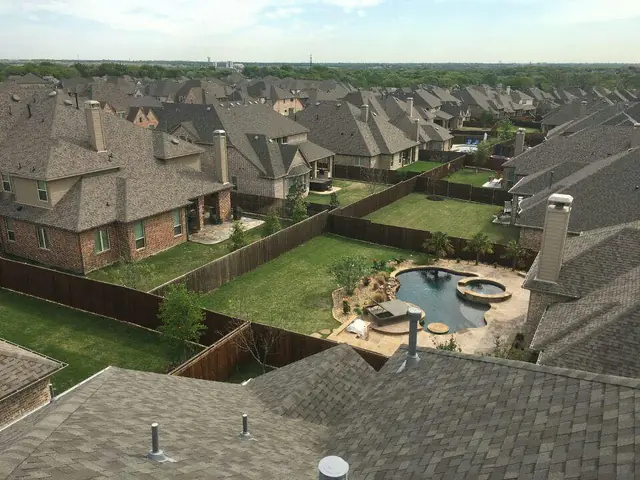
After a North Texas hailstorm, most homeowners do the same thing. They walk outside, tip their head back, and look at the roof from the yard. If nothing looks cracked or missing, they figure it's fine and move on with the week. That's the wrong test, and it's the reason so many storm-damaged roofs go unrepaired until they start leaking, sometimes a year or two after the storm that actually caused the damage.
The driveway test doesn't work
An asphalt shingle is built in layers: a fiberglass mat in the middle, asphalt coating on both sides of it, and a scattering of ceramic-coated granules pressed into the top layer. The granules are what you see from the ground. They are also the least important layer for judging whether the roof is actually damaged, because a hailstone doesn't have to punch through the granules to hurt the shingle underneath them.
What a hailstone actually hits
Hail travels fast enough, and hits at enough of an angle, to compress the shingle against the deck below it without breaking the surface. That compression is what roofers call bruising. The mat fibers underneath fracture or separate, but the granule layer on top can stay put and look completely normal. Press a bruise with a fingertip and it gives slightly, almost spongy, where the shingle around it doesn't. From standing height in the yard, none of that is visible. You have to be on the roof, and you have to know what you're feeling for.
Bruising versus a hole
A hole is obvious and gets fixed because it's obvious. A bruise is the harder case, because the shingle still sheds water the day after the storm. It just doesn't have the strength it had before. Every freeze, every thermal cycle, every gust of wind after that works on the weak spot a little more. Somewhere between six months and three years later, that bruise finally opens into a leak, usually during an ordinary rainstorm that has nothing to do with hail, which is exactly why the homeowner never connects the two events. By then the storm that actually caused it is long past any insurance filing deadline.
Granule loss is a symptom, not the injury
Granule loss gets talked about as if it's the damage itself, and it isn't. It's a marker. Where hail knocked granules loose, it's a sign that the impact was hard enough to matter, but a shingle can lose a meaningful patch of granules and still have an intact mat, or it can keep almost all its granules and still be bruised straight through. An inspector uses granule loss the way a doctor uses a symptom: it tells you where to look closer, not what the diagnosis is.
What an inspector is actually looking for
- Soft spots when the shingle surface is pressed by hand, which usually means the mat underneath has fractured
- Granules collecting in the gutters and at the base of downspouts after a storm, more than normal runoff would carry
- Bruising patterns clustered on the slopes that faced the storm, since wind-driven hail rarely hits a roof evenly
- Damage to soft metal first: vent caps, flashing and gutter aprons dent long before shingles show anything, so they're an early warning
- Whether the mat is exposed anywhere the granules and coating have been stripped away completely
We run free inspections and our staff includes certified adjusters, so the write-up isn't a guess dressed up as an opinion, it's documentation a carrier can act on. If the roof genuinely has years left in it, we'll say that. One of our customers wrote that after a minor hail event we told him his roof was fine for a few more years rather than pushing a full replacement, and that's the standard we hold ourselves to on every inspection, not just the ones that happen to end in good news for the homeowner.
Why it still keeping the rain out isn't the same as it being fine
A bruised roof and an undamaged roof can perform identically for a year. That's the trap. Waiting to see if it leaks is really just waiting to find out how bad the damage was after it's too late to file a claim on it. If your area has taken a hail hit recently, get someone up there who knows the difference between a cosmetic mark and a structural one, before the next storm makes the decision for you. Call 817-823-7224 and we'll get on the roof, not just in the driveway.
MAG Builders, 817-823-7224
Call 817-823-7224More articles
The Insurance Claim Clock: What To Do in the First Week After a North Texas Storm
The week right after a storm is when most claims are won or lost, usually before the homeowner has even called anyone.
Choosing a Roof for Texas Heat
The right roof for a house in North Texas depends on the structure under it as much as the weather on top of it.